Finance and banking
From voucher to reconciled. The whole flow in Holio.
Every kind of voucher, from every channel, into one document centre. The AI reads it, matches it to the purchase order and suggests the posting — and Holio Pay pays and reconciles against the bank. You approve.
- 1 January 2027
- Electronic invoicing becomes mandatory between Norwegian businesses.
- Every channel
- Email, EHF, upload, Holio Chat and Holio Drive.
- PO match
- Line by line against what you actually ordered.
- You decide
- The AI suggests. Nothing is posted or paid without a person.
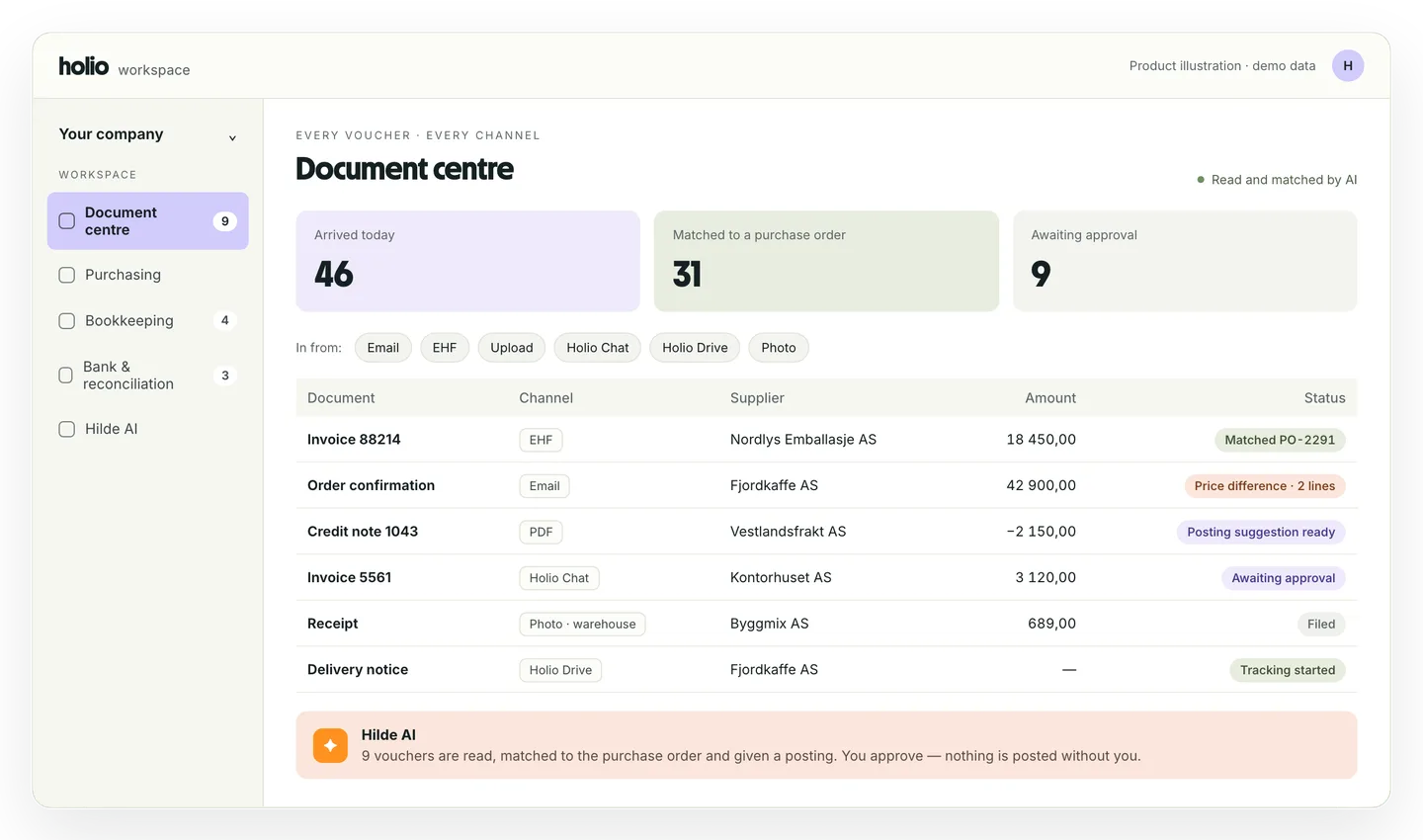
A voucher is not done when it arrives. It is done when it is paid and reconciled.
Every channel in, one queue
Vouchers arrive where suppliers already send them. Every door delivers to the same document centre — and the same file twice is one voucher.
The mailbox you have
Your invoice mailbox is connected. Holio splits the mail into body and attachments and finds the right company — when unsure, it goes to review.
Upload, drag in, take a photo
PDFs, images or a whole ZIP straight into the inbox. A photo taken in the warehouse is a voucher like any other.
Holio Chat and Drive
An attachment in a conversation or a file in Drive goes to the inbox with one click.
EHF and the books
EHF, UBL and CII are read as data. The EHF vouchers Visma Business NXT has received land in the same queue.
The AI reads the voucher and suggests the posting
Holio sees what kind of document it is and who it is from, and reads amounts, VAT, due date, order reference and lines. EHF is read straight from the XML — nothing is guessed there.
The posting suggestion comes with account, VAT code and reasoning, and the AI looks up the chart of accounts and the supplier's earlier vouchers as it works. Where the books hold an approved rule for the supplier, that rule is used instead. If the register does not know the supplier, Holio proposes creating it from the invoice.
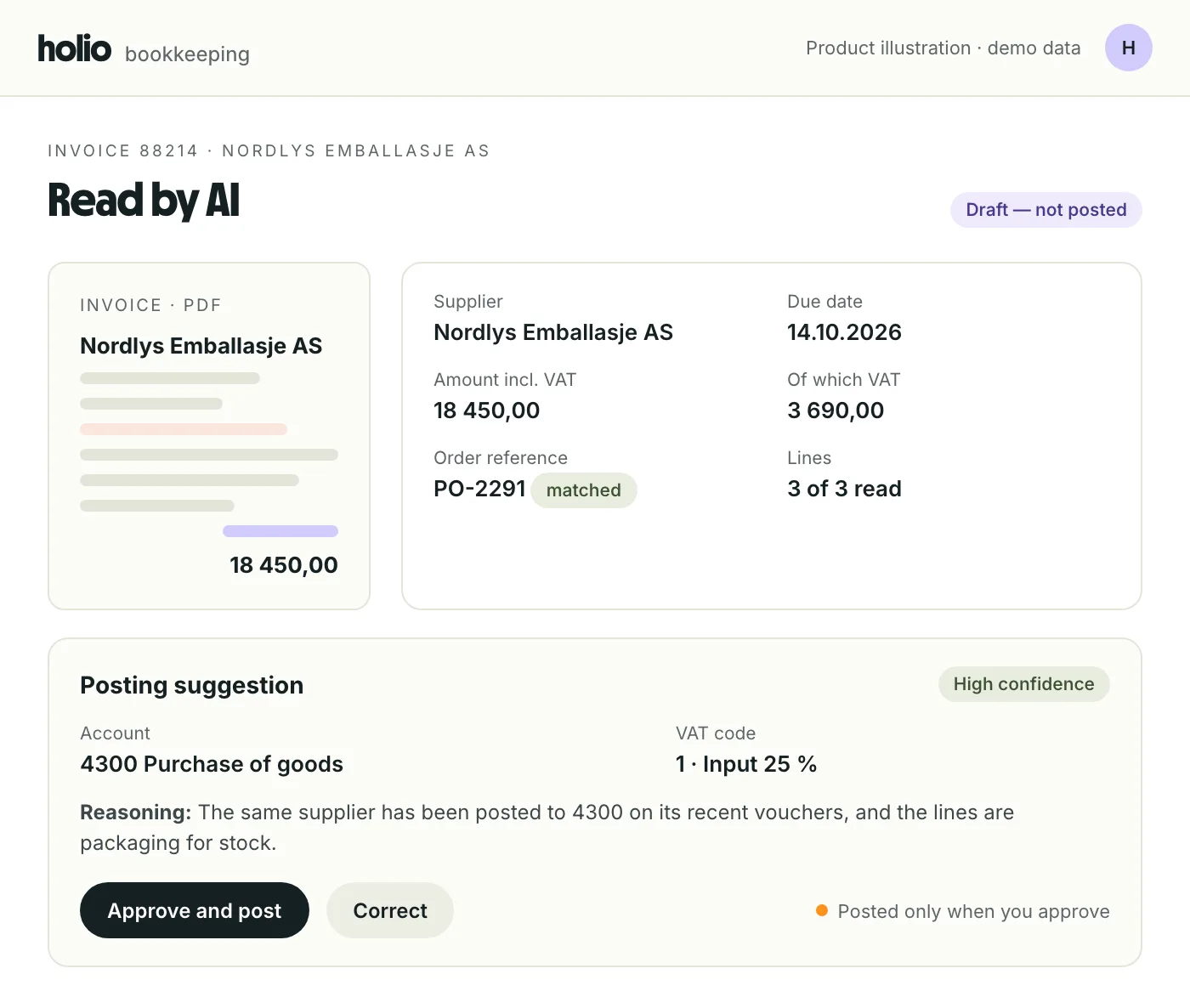
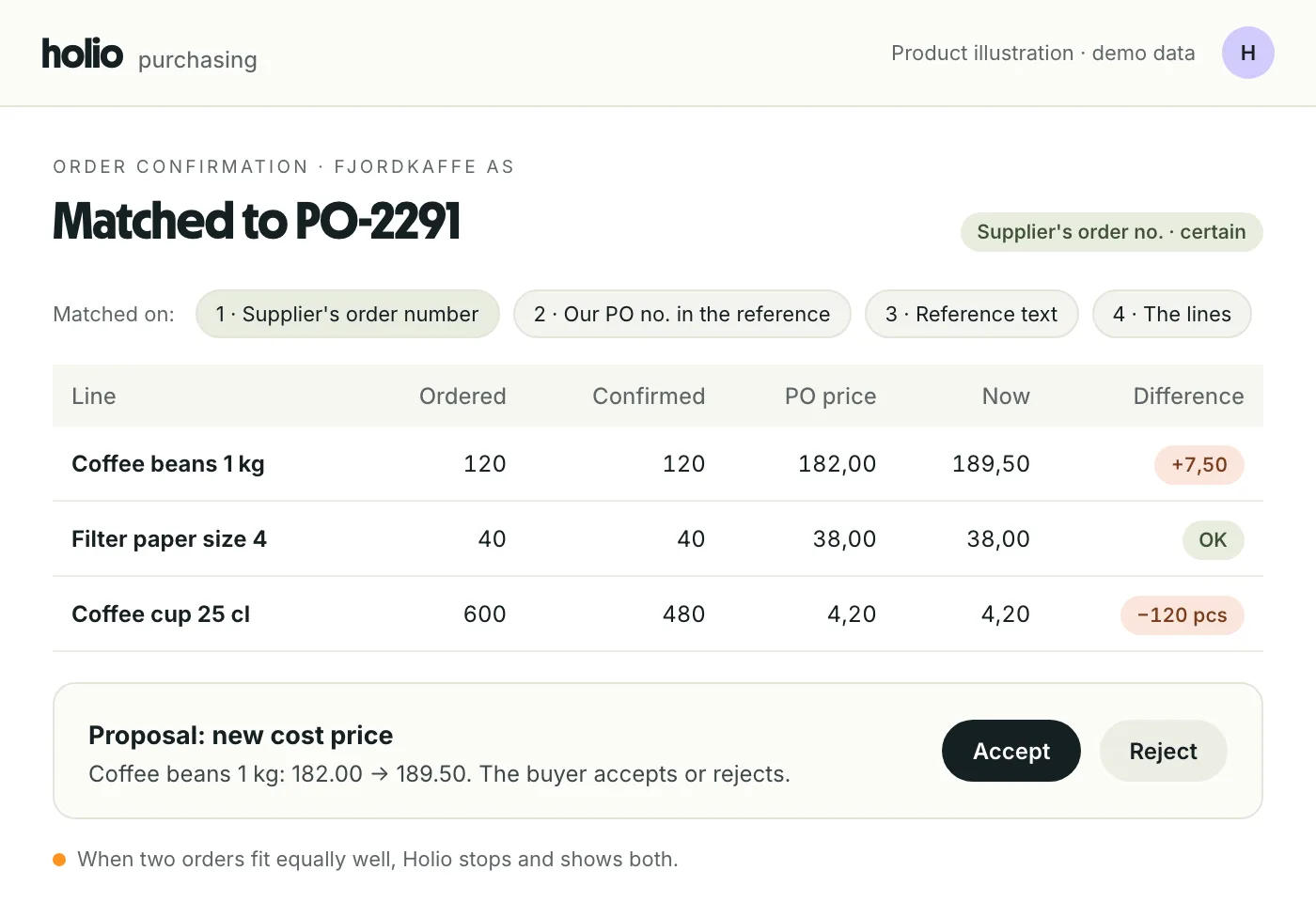
PO match: the invoice against what you actually ordered
The order confirmation and the invoice are matched to the purchase order — first on the supplier's order number, then on our PO number in the reference, then on the reference text and finally on the lines. When two orders fit equally well, Holio stops and shows both.
Differences in price, quantity and date show on the document, not in a spreadsheet afterwards. A price difference becomes a proposed new cost price the buyer accepts or rejects.
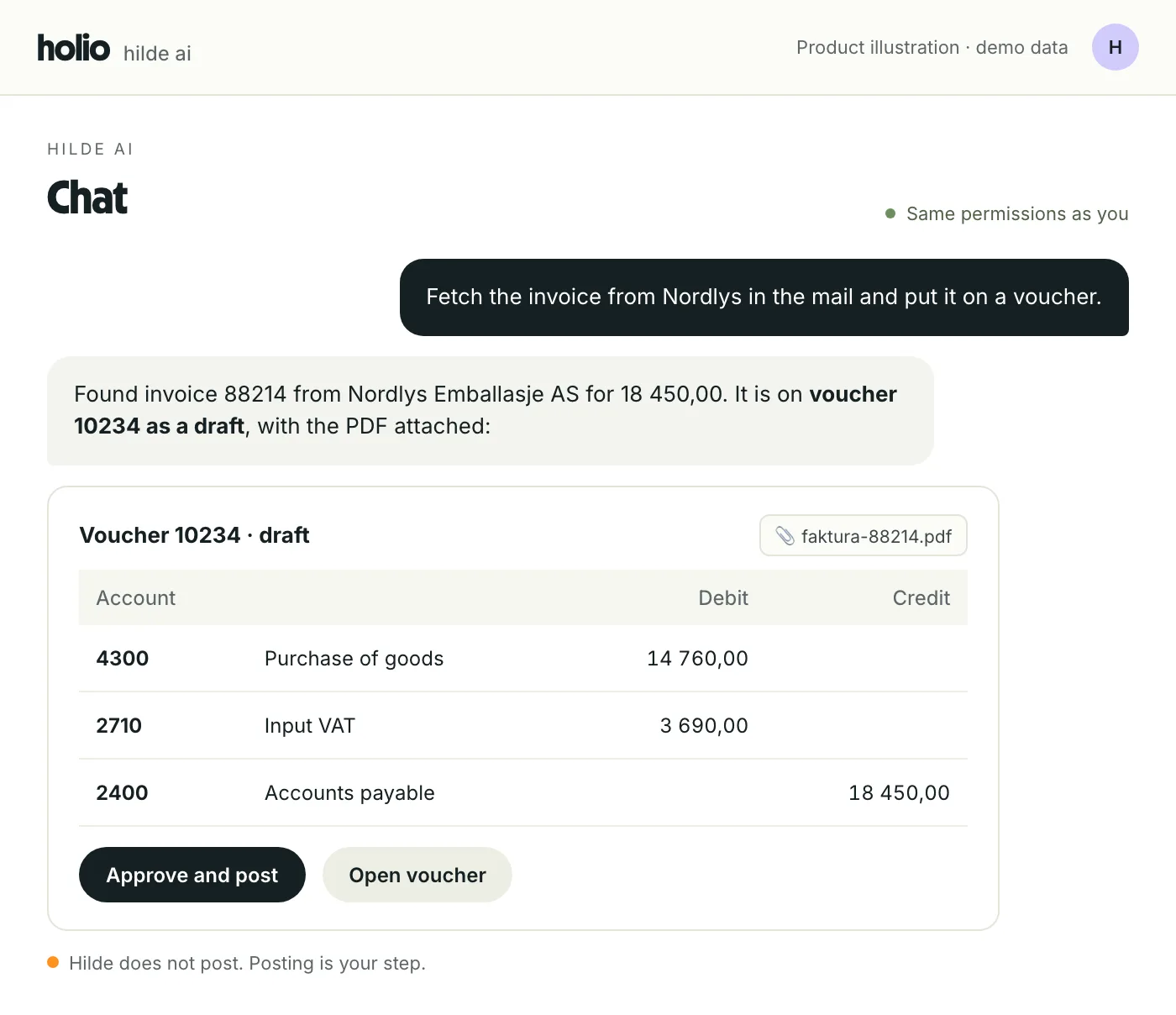
Ask Hilde
«Fetch the invoice from Nordlys in the mail and put it on a voucher.» Hilde finds the mail, reads the attachment, suggests the posting and puts the voucher in the books as a draft, with the PDF attached.
But no model writes to the ledger. The draft can be deleted, and posting is a separate step that takes a person with the right to approve — with the same validation as everything else written to the books.
From supplier invoice to paid and reconciled
Four steps. What you do by hand is approve.
Arrives and is read
From any channel. The AI classifies the voucher and reads its key fields.
Matched to the purchase order
Line by line. Differences become proposals and named tasks, not guesses.
Posted on approval
The voucher waits as a draft with its attachment. It is posted when a person approves.
Paid and reconciled
Through Holio Pay, with the voucher number as the reference, and linked back once the bank has booked it.
Paid is the bank's answer
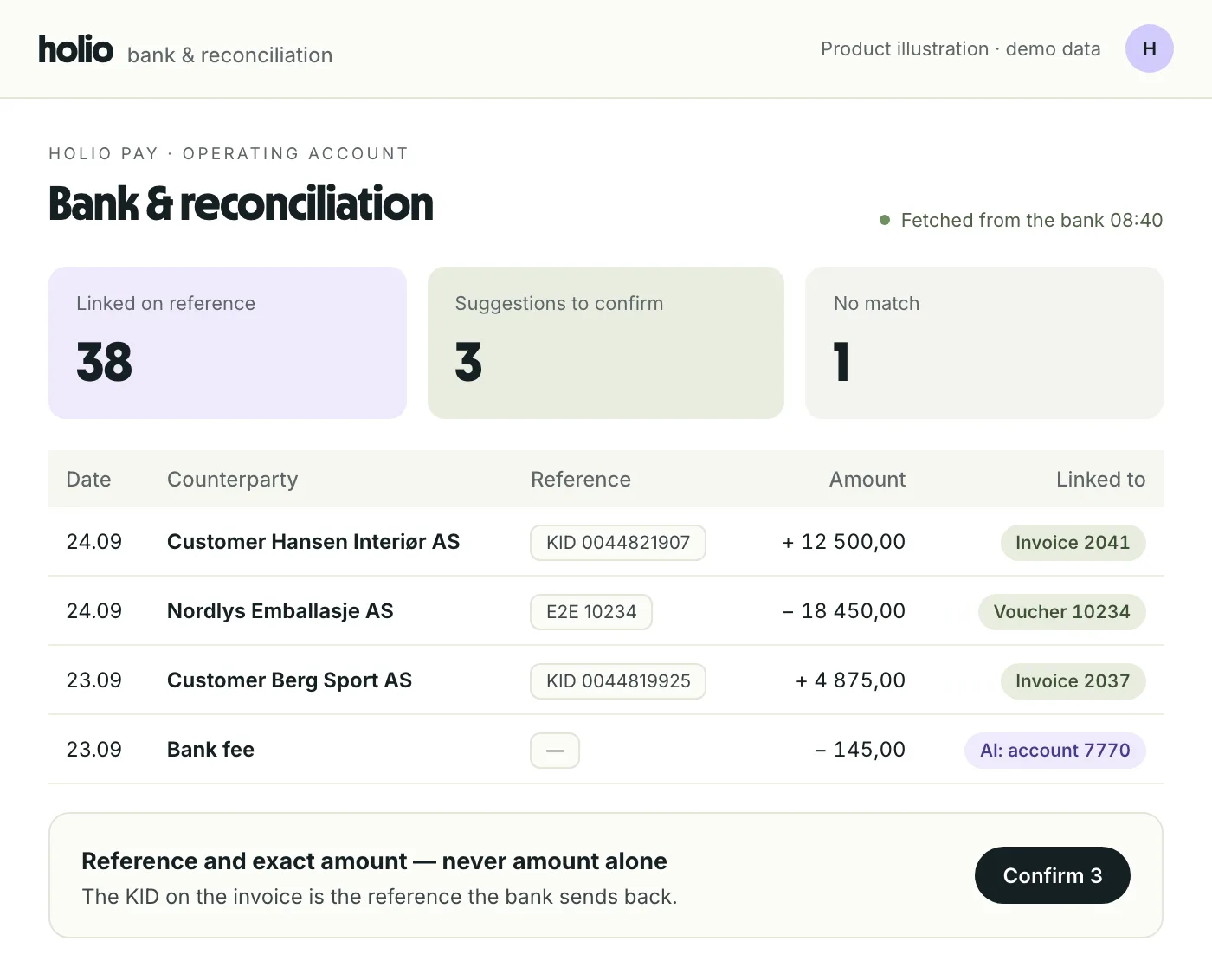
Holio Pay fetches accounts, balances and entries from the bank several times a day. The KID on the customer invoice is the reference the bank sends back, and the voucher number travels with the outgoing payment as its end-to-end reference.
So reconciliation links on reference and exact amount — never on amount alone. An entry with no match gets an AI suggestion instead of a search, and an EHF marked «Delivered» reads as paid only once the money is on the account.
Every kind of voucher, one flow
Not just invoices. Everything that arrives is read and lands where it belongs.
Supplier invoice
Read, matched to the purchase order, posted and paid once approved.
Credit note
Read like an invoice and posted as a credit note.
Order confirmation
Checked against the purchase order before the goods arrive.
Delivery notice
Linked to the shipment, and tracking starts by itself.
Receipt
A photo from a phone becomes a searchable voucher.
Contract and packing slip
Classified and filed under the right supplier.
Customer invoice
Sent as EHF over Peppol, with its KID and a receipt that it arrived.
Bank entry
Fetched through Holio Pay and linked to invoice and voucher.
The books can stay where they are
The document centre, the AI, the EHF channel and the bank connection are Holio's own, and they do not assume you change accounting systems. If you keep the books in Visma Business NXT, the voucher becomes a draft there with its attachment.
Receiving EHF on Holio's own access point is a separate activation. A company has one receiving address on the Peppol network at a time, so the move is planned with you, not flipped with a switch.
What people ask first
Does the AI post on its own?
No. The AI reads, matches and suggests. The voucher it prepares is a draft that can be deleted, and posting to the ledger takes a person with the right to approve.
Which vouchers can we send in?
Supplier invoices, credit notes, order confirmations, delivery notices, receipts and contracts — as EHF, PDF, image, email, ZIP or an Office file. The full list is under Document intake.
Do we need purchase orders?
No. Without a purchase order the invoice goes straight to a posting suggestion and approval. With one, you also get the check against what was ordered.
Do we have to change accounting systems?
No. If you keep the books in Visma Business NXT, vouchers are written there as drafts. What is posted where is your decision.
Can we decide what the invoice looks like?
Yes. Logo, colours, fields and lines are set in Holio — or you describe the invoice to Hilde in the chat and approve the draft. The same PDF goes by e-mail and with the EHF. See Invoice design.
See the whole flow on your own vouchers
Bring a few supplier invoices and a purchase order, and we show how they arrive, are read, matched, posted and reconciled. 45–60 minutes, at no cost.